Abstract
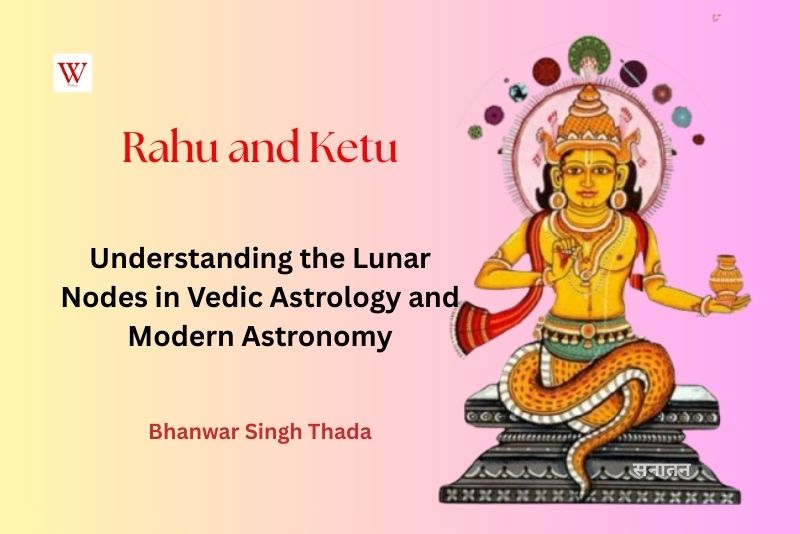
In Vedic astrology (Jyotisha), Rahu and Ketu represent shadow planets known as the lunar nodes, symbolizing karmic influences from past lives and psychological archetypes that shape human consciousness. While classified as non-physical entities in traditional astronomy, modern science identifies them as the ascending and descending nodes of the Moon’s orbit-mathematical points where eclipses occur. This article examines Rahu-Ketu through an interdisciplinary lens, exploring their mythological origins, astrological significance, astronomical basis, psychological interpretations, and evidence-based remedial practices within Hindu philosophical traditions.
1. Introduction: The Concept of Shadow Planets
In the Hindu system of celestial observation, nine celestial bodies (Navagraha) govern cosmic influence on human affairs. Among these, Rahu (☊) and Ketu (☋) are unique-they possess no physical mass yet exert profound astrological effects. Classical texts describe them as Chhaya Grahas (shadow planets), representing:
- Rahu: Illusion (Maya), worldly ambitions, obsession, foreign connections, and sudden transformations
- Ketu: Detachment (Vairagya), spiritual insight, past-life karma, isolation, and mystical knowledge
Unlike the seven physical planets (Sun, Moon, Mars, Mercury, Jupiter, Venus, Saturn), Rahu-Ketu function as invisible forces shaping consciousness, not through gravitational pull, but through karmic and psychological resonance.
2. Mythological Origins: The Samudra Manthan Narrative
2.1 The Churning of the Cosmic Ocean
The Bhagavata Purana narrates the creation of Rahu-Ketu during Samudra Manthan (the churning of the cosmic ocean). When the nectar of immortality (Amrita) emerged, the demon Svarbhanu disguised himself among the gods to consume it. The Sun (Surya) and Moon (Chandra) informed Lord Vishnu, who beheaded Svarbhanu with his Sudarshana Chakra. However, having consumed Amrita, Svarbhanu became immortal:
- Rahu: The severed head, representing the insatiable mind craving experiences
- Ketu: The decapitated body, symbolizing detachment from worldly existence
This myth encodes psychological archetypes: Rahu as unfulfilled desires and Ketu as consequence-free liberation.
2.2 Vedic References
The Rigveda (5.40.5-9) mentions Rahu as Svarbhanu, the entity that eclipses celestial luminaries:
“स्वर्भानुर्माध्यमदिन्द्रम्”
“Svarbhanu obscures the light at midday”
This verse predates the Puranic narrative, indicating ancient astronomical awareness of eclipse phenomena.
3. Astronomical Basis: The Lunar Nodes
3.1 Orbital Mechanics
Modern astronomy identifies Rahu and Ketu as the lunar nodes-the two points where the Moon’s orbital plane intersects Earth’s ecliptic plane:
- Rahu (North Node): The ascending node where the Moon crosses from south to north
- Ketu (South Node): The descending node where the Moon crosses from north to south
These nodes precess westward at approximately 19.34° per year, completing a cycle every 18.6 years (Saros cycle).
3.2 Eclipse Phenomenon
Solar and lunar eclipses occur only when the Sun, Moon, and Earth align near these nodal points:
- Solar Eclipse: Occurs at New Moon near Rahu/Ketu
- Lunar Eclipse: Occurs at Full Moon near Rahu/Ketu
Ancient Indian astronomers like Aryabhata (476-550 CE) scientifically explained eclipses as shadows cast by Earth/Moon, rejecting the “demon swallowing” interpretation-yet retained the symbolic names Rahu-Ketu for nodal calculations.
3.3 Gravitational and Geomagnetic Effects
Recent studies suggest eclipse events correlate with:
- Geomagnetic field fluctuations during solar eclipses (Hayakawa et al., 2016)
- Shifts in circadian rhythms among organisms (Becker-Weimann et al., 2004)
- Psychological disturbances potentially linked to electromagnetic changes (Ghione et al., 1998)
While correlational, this research provides a scientific basis for ancient observations about Rahu-Ketu influencing mental states during eclipses.
4. Astrological Interpretation
4.1 Rahu’s Characteristics
In Vedic horoscopy, Rahu governs:
- Psychological traits: Ambition, confusion, sudden insights, foreign fascinations
- Life areas: Technology, politics, unconventional careers, foreign travel, addictions
- Positive manifestations: Innovation, breakthroughs, material success
- Negative manifestations: Deception, anxiety disorders, obsessive behavior
Textual Source:
Brihat Parashara Hora Shastra describes Rahu as: “blue-bodied, intelligent, terrifying, diseased, and capable of inflicting suffering.”
4.2 Ketu’s Characteristics
Ketu represents:
- Psychological traits: Detachment, introspection, spiritual hunger, indifference
- Life areas: Mysticism, occult sciences, liberation (Moksha), research, isolation
- Positive manifestations: Enlightenment, psychic abilities, freedom from materialism
- Negative manifestations: Depression, aimlessness, self-sabotage
Textual Source:
Brihat Parashara Hora Shastra states: “Ketu resembles Rahu but inclines toward spiritual knowledge and renunciation.”
4.3 Karmic Axis
Together, the Rahu-Ketu axis forms the karmic axis in the natal chart:
- Rahu’s house: Areas requiring growth, new experiences, karmic lessons
- Ketu’s house: Areas of past-life mastery, natural talents, but also detachment
This axis reveals the soul’s evolutionary direction in Vedic philosophy.
5. Psychological Interpretation: Carl Jung’s Perspective
Modern depth psychology offers parallels to Vedic concepts:
- Rahu = Shadow Self (Jungian): Unconscious desires, projections, and unintegrated aspects of the psyche seeking expression
- Ketu = Spiritual Self: The transcendent function pulling consciousness toward wholeness beyond ego
This suggests Rahu-Ketu symbolism transcends cultural boundaries, representing universal psychological dynamics.
6. Scientific Evaluation of Astrological Claims
6.1 Critique
The scientific community generally rejects astrological causality due to:
- Lack of physical mechanism: Lunar nodes exert no gravitational/electromagnetic force
- Statistical failure: Controlled studies find no predictive validity (Carlson, 1985)
- Cognitive biases: Confirmation bias and Barnum effect explain perceived accuracy
6.2 Cultural Defense
Proponents argue:
- Non-material causality: Vedic astrology operates on karmic resonance, not Newtonian physics
- Symbolic language: Planets as archetypes, not literal causes
- Empirical tradition: Thousands of years of observational refinement
This represents an epistemological divide between materialist and consciousness-based paradigms.
7. Remedial Practices: Evidence-Based Analysis
Vedic tradition prescribes rituals (Upayas) to mitigate malefic Rahu-Ketu influences. Below we analyze these through psychological and neuroscientific lenses.
7.1 Mantra Recitation (Japa)
Practice:
Reciting seed mantras:
- Rahu: “ॐ रां राहवे नमः” (Om Ram Rahave Namah)
- Ketu: “ॐ कें केतवे नमः” (Om Kem Ketave Namah)
Scientific Mechanism:
- Neuroplasticity: Repetitive vocalization activates parasympathetic nervous system, reducing cortisol (stress hormone) (Bernardi et al., 2001)
- Meditation effect: Mantra meditation increases gray matter density in brain regions associated with emotional regulation (Hölzel et al., 2011)
Conclusion: While mantras don’t “appease planets,” they induce meditative states that address anxiety and confusion-the psychological symptoms attributed to Rahu-Ketu.
7.2 Charity (Dāna)
Practice:
Donating specific items on Saturdays:
- Rahu: Black sesame, iron vessels, blue fabrics
- Ketu: Blankets, coconuts, white cloth
Psychological Mechanism:
- Altruism effect: Charitable acts trigger dopamine release and increase life satisfaction (Dunn et al., 2008)
- Cognitive reframing: Acts of generosity reduce self-centered rumination, a feature of Rahu’s obsessive nature
Textual Justification:
Garuda Purana states: “Donation destroys the excess of enjoyment and removes planetary afflictions.”
7.3 Deity Worship (Shiva and Ganesha)
Practice:
- Worshipping Lord Shiva for Rahu (Mondays)
- Worshipping Lord Ganesha for Ketu (Chaturthi)
Symbolic Analysis:
- Shiva: Represents transcendence of duality-counteracting Rahu’s illusions
- Ganesha: Remover of obstacles-balancing Ketu’s stagnation
Neuroscience of Ritual:
Ritual participation activates Default Mode Network (DMN), fostering psychological coherence and community bonding (Schjoedt et al., 2013).
7.4 Sattvic Lifestyle
Practice:
Avoiding intoxicants, violence, dishonesty; practicing meditation and vegetarianism.
Ayurvedic Correlation:
Rahu increases Rajas (agitation) and Tamas (inertia), while Sattva (purity) balances both. Modern science confirms:
- Diet-mood connection: Processed foods correlate with depression; plant-based diets improve mental clarity (Jacka et al., 2017)
- Mindfulness: Reduces amygdala reactivity (Rahu’s fear) and enhances prefrontal regulation (Ketu’s insight) (Tang et al., 2015)
7.5 Self-Knowledge (Atma-Jnana)
Ultimate Remedy:
The Upanishads declare:
“नायमात्मा ग्रहणेन लभ्यः”
“The Self cannot be attained through external means alone.”
This implies Rahu-Ketu’s influence dissolves through self-awareness-a concept mirrored in modern psychotherapy’s emphasis on insight-oriented treatment.
8. Cross-Cultural Parallels
8.1 Western Astrology
Western astrology also uses lunar nodes:
- North Node (Rahu): Future potential, life purpose
- South Node (Ketu): Past-life talents, comfort zones
The meanings align remarkably with Vedic interpretations, suggesting archetypal universality.
8.2 Chinese Astrology
Chinese texts mention Jidu (Ketu) and Luohou (Rahu) as eclipse demons, indicating shared Indo-Chinese astronomical knowledge via the Silk Road.
9. Contemporary Relevance
9.1 Globalization and Rahu
In the 21st century, Rahu’s domain-technology, media, globalization-dominates human life. Understanding Rahu psychologically helps navigate:
- Information overload (digital Rahu)
- Identity fragmentation (social media illusions)
- Instant gratification culture (Rahu’s insatiability)
9.2 Mental Health Crisis and Ketu
Rising existential depression mirrors Ketu’s influence-disconnection from meaning. Ketu-oriented practices (meditation, minimalism, spirituality) offer antidotes to modern alienation.
FAQs: Frequently Asked Questions
Q1: Are Rahu and Ketu real planets?
A: No. Astronomically, they are mathematical points (lunar nodes) where the Moon’s orbit intersects Earth’s ecliptic. They have no mass or gravitational influence.
Q2: Can Rahu-Ketu effects be scientifically proven?
A: Direct astrological causality lacks scientific validation. However, eclipse-related geomagnetic changes and psychological effects of ritual practices have empirical support.
Q3: Who should perform Rahu-Ketu remedies?
A: From a psychological perspective, anyone experiencing anxiety, confusion (Rahu), or existential emptiness (Ketu) may benefit from meditative and ethical practices associated with these remedies.
Q4: Do these remedies work instantly?
A: No. Like psychotherapy, they require consistent practice over time to recondition thought patterns and behaviors.
Q5: Can non-Hindus practice these remedies?
A: Yes. The psychological and lifestyle components (meditation, charity, ethical living) are universal and can be adapted to any belief system.
10. Conclusion
Rahu and Ketu occupy a unique space bridging mythology, astronomy, and psychology. While their physical non-existence challenges materialist frameworks, their symbolic and psychological utility remains profound. The astronomical reality of lunar nodes, combined with eclipse-related geomagnetic effects, suggests ancient observers encoded genuine phenomena in mythological language.
Modern practitioners may interpret Rahu-Ketu not as supernatural forces but as:
- Psychological complexes requiring integration
- Karmic patterns reflecting behavioral conditioning
- Symbolic narratives offering therapeutic metaphors
The remedial practices, though religious in form, function as cognitive-behavioral interventions: mantra meditation induces calm, charity reduces narcissism, lifestyle changes improve mental health, and self-inquiry fosters psychological integration.
In an era seeking to reconcile science and spirituality, Rahu-Ketu exemplify how ancient wisdom traditions embedded sophisticated psychological insights within cosmological frameworks-insights that remain relevant for contemporary seekers navigating the eternal tension between material desire (Rahu) and spiritual liberation (Ketu).
References
- Becker-Weimann, S., et al. (2004). “Entrainment to the 24-h light-dark cycle.” Chronobiology International, 21(4-5), 501-520.
- Bernardi, L., et al. (2001). “Effect of rosary prayer and yoga mantras on autonomic cardiovascular rhythms.” BMJ, 323(7327), 1446-1449.
- Carlson, S. (1985). “A double-blind test of astrology.” Nature, 318(6045), 419-425.
- Dunn, E.W., et al. (2008). “Spending money on others promotes happiness.” Science, 319(5870), 1687-1688.
- Ghione, S., et al. (1998). “Do geomagnetic disturbances affect arterial blood pressure?” Journal of Human Hypertension, 12(11), 749-754.
- Hayakawa, H., et al. (2016). “East Asian observations of solar eclipses.” Solar Physics, 291(5), 1555-1578.
- Hölzel, B.K., et al. (2011). “Mindfulness practice leads to increases in regional brain gray matter density.” Psychiatry Research, 191(1), 36-43.
- Jacka, F.N., et al. (2017). “A randomised controlled trial of dietary improvement for adults with major depression.” BMC Medicine, 15(1), 23.
- Parashara, Maharishi. Brihat Parashara Hora Shastra. (Classical text, multiple translations)
- Schjoedt, U., et al. (2013). “Cognitive resource depletion in religious interactions.” Religion, Brain & Behavior, 3(1), 39-55.
- Tang, Y.Y., et al. (2015). “The neuroscience of mindfulness meditation.” Nature Reviews Neuroscience, 16(4), 213-225.
- Vyasa, Krishna-Dwaipayana. Bhagavata Purana. (Classical text)
About Wikindia.org
This article is part of Wikindia’s mission to present Indian knowledge systems with academic rigor, bridging traditional wisdom and contemporary scholarship for a global audience.
Also Read –