
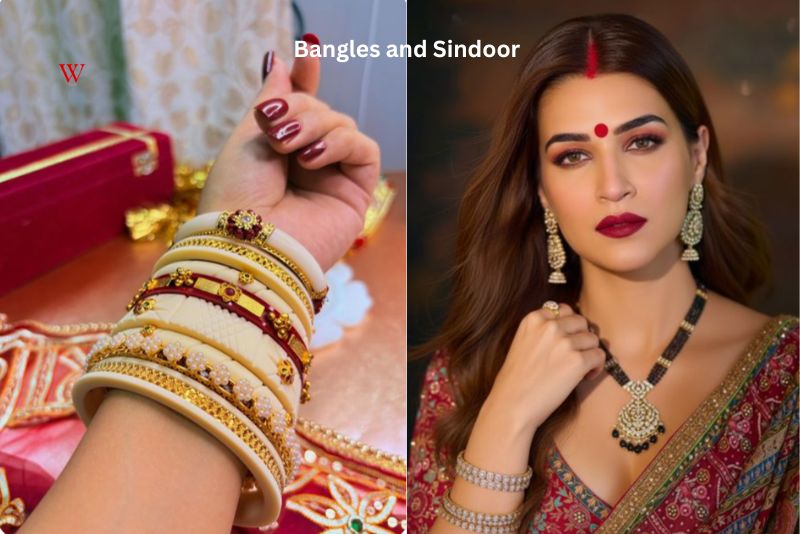
To someone seeing Indian traditions from the outside, bangles and sindoor may appear to be simply beautiful adornments. But for millions of women across the Indian subcontinent, they have long carried meanings that go far beyond appearance. They can symbolize marriage, blessing, continuity, affection, identity, and a deeply personal connection to family tradition. Bangles also have remarkable historical depth in India: The Metropolitan Museum of Art lists an Indian copper bangle dated 1500-500 BCE, showing just how ancient the ornament is, while another Met essay notes that bangles were historically associated with married life in Indian tradition.
1. More Than Ornament: A Language of Culture
In Indian culture, adornment has often functioned as a visual language. Jewelry, color, and ritual objects can communicate life stage, community belonging, celebration, devotion, and social identity. In that larger cultural framework, bangles and sindoor are not merely decorative details; they often participate in rites of passage and family memory. The Met specifically describes jewelry in India as connected to important life events, and identifies bangles as objects historically linked to marriage.
2. What Sindoor Signifies
Sindoor, the red or orange-red powder applied along the hair parting, is widely recognized in many Hindu communities as a sign of marriage. Anthropological research on Hindu marriage rituals describes sindoor as a sacred and auspicious marker that signifies a woman’s entry into married life, while the color red is associated with fertility, power, and auspiciousness. Hinduism Today likewise notes that sindoor placed at the parting of the hair signifies that a woman is married and is regarded as a sign of saubhagya, or good fortune.
Yet the emotional meaning of sindoor is often even deeper than its symbolic one. For many women, it is not just a mark seen by society; it is part of the intimacy of marriage, family rituals, festivals, and inherited customs. It can represent prayer, affection, blessings for the husband’s well-being, and a sense of being connected to mothers and grandmothers who wore it before them. In that sense, sindoor is both public and personal.
3. Why Bangles Matter
Bangles have their own powerful cultural vocabulary. Their circular form is often associated with continuity, completeness, and harmony. In many traditions, the sound of glass or metal bangles is linked with joy, auspiciousness, and the presence of a married woman in the household. Historically, bangles were not just fashion accessories; they were part of ceremonial identity. The Met notes that while bangles are now worn widely, they were historically reserved for women after marriage, placing them within the broader framework of rites of passage.
There is also an emotional layer that makes bangles especially meaningful. Their sound can evoke memories of weddings, festivals, new beginnings, and shared domestic life. In many homes, the soft clinking of bangles is associated with warmth, celebration, and feminine presence. For this reason, bangles are often remembered not only as objects of beauty, but as carriers of mood, memory, and belonging.
4. A Tradition That Changes Across Regions
It is important to understand that India is not culturally uniform. The meaning, color, material, and style of bangles can vary dramatically from one region or community to another. In some places, red and green bangles are especially associated with marriage; in others, ivory, conch shell, gold, lac, or glass may play a central role. The same is true of sindoor: for some women it is a daily practice, for others it is worn mainly during festivals, rituals, or family occasions. Traditions also differ across religious, regional, and family lines.
That diversity matters because it reminds us that there is no single story of Indian womanhood. Bangles and sindoor may be deeply cherished by one woman, occasionally worn by another, or consciously reinterpreted by someone who values tradition but wants to practice it in her own way. The strongest understanding of these symbols is therefore not rigid, but layered and respectful.
5. The Modern Meaning: Choice, Identity, and Continuity
In the modern world, bangles and sindoor are no longer understood only through the lens of convention. For many women today, they are part of a more personal relationship with culture. Some wear them proudly every day as an expression of faith, marriage, and heritage. Some wear them on festivals, weddings, and special family moments. Others may choose not to wear them at all, while still valuing the tradition they come from.
This shift does not necessarily weaken tradition; in many cases, it makes it more meaningful. When a custom is worn by choice, it becomes less about social pressure and more about identity. Bangles and sindoor then move from obligation to expression-something intimate, graceful, and self-defined.
6. A Necessary Modern Note on Safety
Any contemporary discussion of sindoor should also mention product safety. Hinduism Today warns that many modern synthetic sindoor products have been made with harmful substances such as lead, industrial dyes, and other toxic materials, and recommends safer, non-toxic alternatives. This is an important reminder that while the tradition is ancient, modern consumers should choose products carefully and prioritize quality and safety.
7. So, Why Do Women Wear Bangles and Sindoor?
The simplest answer is this: women wear bangles and sindoor because these symbols have, for generations, expressed love, marriage, auspiciousness, beauty, and cultural identity. But the fuller answer is more human. They are worn because traditions often survive not only through rules, but through emotion. Through the memory of a wedding morning. Through the blessing of elders. Through the desire to carry one’s culture with elegance. Through the quiet feeling that some symbols do not merely decorate the body – they tell a story.
And perhaps that is why these traditions continue to endure. Bangles and sindoor are not just about how a woman looks. They are about what she carries: memory, meaning, belonging, and choice.
Sources
- The Met Museum – Bangle (1500-500 BCE, India)
- The Met Museum – Rites of Passage in the Indian Jewelry Tradition
- Canadian Center of Science and Education – Significance of Sindoor in Hindu Marriage Rituals
- Hinduism Today – The Hazards of Synthetic Sindoor
Recommend –

