
Ancient Indian Wisdom: A Scientific Legacy Beyond Modern Understanding
“What modern laboratories are discovering today was already known to India’s rishi-scientists thousands of years ago!”
The 1,600-year-old Iron Pillar standing tall in Delhi’s Qutub Complex continues to astonish scientists. It is not just a marvel of history but also living proof of ancient India’s mastery in metallurgy and nanotechnology. Modern science discovered in 2003 that the pillar’s phosphorus-rich nano-layer protects it from rust, but the real question is: Did ancient Indian metallurgists possess knowledge of nano-scale engineering?
Ancient India’s Science: Ahead of Modern Technology
- The Mystery of Nano-Coating: A 50-100 nanometer thick layer (misawite) was found on the pillar’s surface, formed naturally from iron and oxygen-similar to today’s self-healing materials.
- The Role of Phosphorus: While phosphorus is considered an impurity in modern iron, ancient Indians intentionally used 1% phosphorus to create a protective film, which scientists believe was “not an accident but a deliberate technique.”
- Nanotechnology in Vedas & Ayurveda: Ayurvedic bhasma (microscopic metal residues) are essentially nanoparticles used in medicine. Even today, Swarna Bhasma (gold nanoparticles) remains a subject of research.
A Challenge to Modern Scientists
From NASA to IIT, researchers are studying the pillar’s anti-corrosion technology, which could revolutionize nuclear plants and car engines. But the biggest question remains: Can we ever fully decode this ancient knowledge?
“This pillar is not just a piece of iron-it is a symbol of India’s scientific civilization, where science and spirituality walked hand in hand!”
Did You Know?
- It is believed that wishes are granted to those who touch the pillar, blending its scientific and spiritual significance.
- Gupta-era metallurgists purified iron at 1,400°C, surpassing the capabilities of many modern methods.
Read on to discover: How ancient India’s nanotechnology remains a benchmark for today’s scientists!
A 1,600-Year-Old Marvel That Defies Science
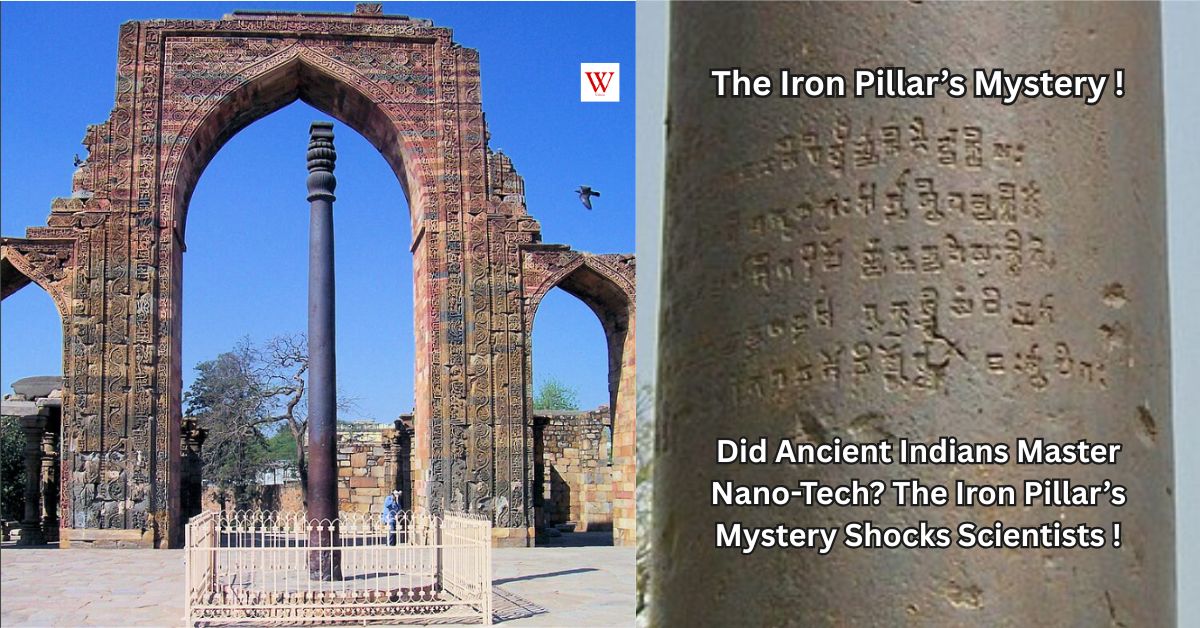
Standing tall in Delhi’s Qutub Complex, the Iron Pillar of Delhi has baffled scientists, historians, and metallurgists for centuries. Weighing over 6 tons and dating back to 4th century CE, this 7-meter-high pillar has not rusted despite being exposed to harsh weather for 1,600 years.
How is this possible?
- Did ancient Indians possess advanced nano-technology?
- Was there a lost metallurgical technique that modern science is still decoding?
- What does NASA and global research say about this?
This blog dives deep into the scientific, historical, and archaeological evidence behind the Iron Pillar’s rust-resistant mystery-proving that ancient India’s knowledge was far ahead of its time.
1. The Iron Pillar: An Engineering Miracle
Quick Facts (Table)
| Feature | Detail |
|---|---|
| Location | Qutub Minar Complex, Delhi |
| Height | 7.21 meters (23.8 ft) |
| Weight | Over 6,000 kg |
| Age | ~1,600 years (Gupta Empire) |
| Composition | 98% pure wrought iron |
| Unique Trait | No rust despite centuries of exposure |
Why Is This Impossible?
Modern iron, even with anti-corrosion treatments, rusts within decades. Yet, the Iron Pillar remains pristine. Scientists discovered a thin protective layer-just 50–100 nanometers thick-that acts as a natural shield against rust.
2. The Science Behind the Rust-Proof Shield
The “Passive Protective Film” Theory
In 2002, a team from IIT Kanpur and National Physical Laboratory (India) used X-rays and spectroscopy to analyze the pillar. They found:
✅ High Phosphorus Content (1%) – Unlike modern iron (0.05% P), the pillar’s unusual phosphorus ratio reacted with air to form iron hydrogen phosphate hydrate, a self-healing nano-layer preventing rust.
✅ Low Sulfur & Magnesium – These impurities accelerate rust, but the pillar’s iron was exceptionally pure.
✅ Microclimate Effect – Delhi’s dry weather helps, but even in humid conditions, the pillar resists corrosion.
Comparison: Ancient vs. Modern Anti-Rust Tech (Table)
| Factor | Ancient Iron Pillar | Modern Stainless Steel |
|---|---|---|
| Corrosion Resistance | 1,600+ years | 50–100 years |
| Protective Layer | Self-forming nano-film (FePO₄·H₂O) | Chromium oxide layer |
| Material Purity | 98% iron, 1% phosphorus | Iron + 10–30% chromium |
| Eco-Friendly? | Yes (no chemicals) | Requires toxic coatings |
Conclusion: Ancient Indian metallurgists accidentally or intentionally used phosphorus-rich iron, creating a nano-coating centuries before modern science understood it.
3. Did Ancient India Really Know Nano-Technology?
Evidence from Ancient Texts
- Arthashastra (Kautilya, 300 BCE) mentions advanced metal purification techniques.
- Rasaratna Samuccaya (Vedic Alchemy) describes iron treatments resembling passivation.
- Iron Beams in Konark Temple – Another example of rust-resistant ancient Indian ironwork.
NASA’s Interest in the Pillar
NASA scientists studied the pillar’s anti-corrosion properties for spacecraft materials. The self-forming protective layer could revolutionize long-term metal preservation in extreme environments.
4. Modern Attempts to Replicate the Technology
Why Can’t We Recreate It Today?
- Lost Techniques – The exact smelting & forging process is unknown.
- Phosphorus Problem – Too much phosphorus makes modern iron brittle, but the pillar’s iron remains durable.
- Natural Aging – The pillar’s 1,600-year exposure helped its protective layer mature-something labs can’t replicate quickly.
Ongoing Research
- IISc Bangalore is testing ancient Indian iron-making methods.
- DRDO (Defense Research) is exploring military applications of similar coatings.
5. Conclusion: A Testament to Ancient India’s Scientific Genius
The Iron Pillar isn’t just a historical artifact-it’s proof of India’s forgotten scientific prowess. While we may never fully decode its secrets, it stands as a symbol of how ancient knowledge could inspire future innovations.
Key Takeaways
✔ Ancient Indians used high-phosphorus iron, creating a nano-scale protective film.
✔ Modern science still can’t perfectly replicate this 1,600-year-old technology.
✔ NASA & global researchers are studying it for advanced material science.
Next Time You Visit Delhi: Touch the Iron Pillar and marvel-you’re touching a metal that defies time itself!
Read Also –


[…] The Iron Pillar Mystery: Ancient Indian Nanotechnology […]